
Have you ever looked at a problem and thought, someone should really do something about that?
There’s a quote that’s often shared online attributed to Lily Tomlin that says something along the lines of, “I looked around and said, somebody should do something about that. Then I realized I am somebody.” I love the message behind it, even if that’s not the exact phrasing.
Every meaningful organization, movement, or business started because one person noticed a problem and decided to become part of the solution.
For me, that journey started by fostering cats and kittens.
At the time, fostering felt like a huge step. I certainly never imagined it would eventually lead me to creating Still Worth Saving, a nonprofit dedicated to helping special-needs cats. But before I ever filed paperwork or assembled a board of directors, I found myself asking a much bigger question.
Should this even be a nonprofit?
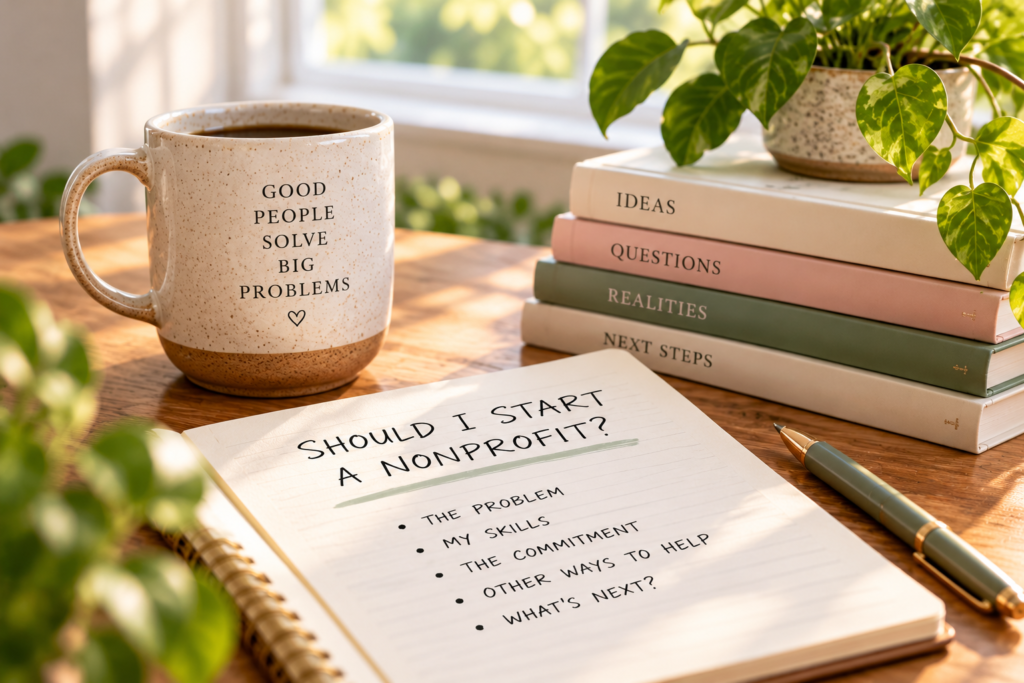
I Didn’t Start With the Legal Structure
As a former accountant and current business owner, I have to admit that starting a nonprofit wasn’t my first choice.
In fact, I probably had some of the same misconceptions many people have. I knew nonprofits came with paperwork, regulations, fundraising, board meetings, and ongoing compliance. It felt like a lot of red tape. Part of me wondered if there might be an easier way without some of the
I spent a lot of time exploring the options. If I’m being honest, I also spent a lot of time overthinking. I delayed moving forward because I wasn’t sure I was the right person for the job. Fear and self-doubt have a way of disguising themselves as “doing more research.”
I remember sitting at my computer with multiple tabs open trying to compare nonprofits, businesses, and social enterprises. I kept thinking there had to be a perfect answer. Eventually I realized there wasn’t. There was simply the answer that best supported the mission.
I already knew how to start a for-profit business. That part didn’t intimidate me. But this was different. I found myself asking questions I’d never considered before. Could this simply become another business? What exactly is a social enterprise? Would partnering with an existing organization have a bigger impact? Or should I simply continue volunteering and donating personally?
Looking back, I’m incredibly thankful I asked those questions before filing a single document.
If you’ve found yourself wondering many of the same things, you’re in the right place. This article is not meant to advise you on the legalities or financial benefits but rather to give you a starting point to start considering how best to be the solution to the problem you are seeing right in front of you.
The World Doesn’t Need More Nonprofits
That might sound like a strange statement coming from someone who recently started one, so let me explain.
The world doesn’t need more nonprofits. It just needs more people who are willing to solve meaningful problems.
Those problems come in all shapes and sizes. They might be as large as providing clean water to communities around the world. They might be helping families experiencing homelessness. They might be supporting veterans, protecting local parks, or making sure a special-needs cat gets the medical care it deserves.
The size of the problem isn’t what matters.
What matters is that someone cares enough to do something about it.
And that “someone” might be you.
Start With the Mission
Before you spend time researching legal structures, filing paperwork, or thinking about board members, take time to clearly define your mission.
Ask yourself questions like:
- What problem am I trying to solve?
- Who am I trying to help?
- What change do I hope to create?
- Is another organization already solving this problem well?
- What role do I actually want to play?
I believe these questions are far more important than deciding whether or not you should become a nonprofit.
In fact, one of the biggest lessons I learned is that having a mission doesn’t automatically mean you need a nonprofit.
Understanding Your Options
Once your mission is clear, it’s much easier to determine what type of organization will best support it.
A traditional business
A business primarily exists to sell products or services and generate a profit.
That doesn’t mean businesses can’t make an incredible impact. There are so many ways to improve people’s lives and make a difference in the world and it doesn’t require tax-exempt status from the IRS. Sometimes people think of businesses as faceless corporations focused only on profits. In reality, most businesses begin with one person who saw a problem and believed they could make life a little better for someone else.
Profit and purpose can absolutely exist together.
A social enterprise
A social enterprise is also a business, but the mission is woven directly into the business model.
Instead of existing solely to maximize profit, the business is intentionally designed to create both financial sustainability and social impact.
For example, a social enterprise might:
- Donate a percentage of every sale.
- Employ people who face barriers to employment.
- Create products that directly solve a social problem.
- Use profits to fund programs that support its mission.
Customers become part of the mission every time they make a purchase.
A nonprofit
A nonprofit exists primarily to serve a charitable mission rather than generate profits for owners or shareholders.
Most nonprofits rely on some combination of donations, grants, sponsorships, fundraising events, and program revenue to support their work.
A nonprofit may be the right choice if:
- You’ll rely primarily on donations or grants.
- Tax-deductible giving is important to your fundraising strategy.
- Your focus is creating public benefit rather than earning profits.

Maybe You Don’t Need to Start Anything
This may actually be the most important point to remember as you think through these options.
Sometimes the best way to make a difference isn’t creating a new organization at all.
You might make the greatest impact by:
- Volunteering.
- Joining a nonprofit board.
- Becoming a foster.
- Mentoring someone.
- Advocating for a cause.
- Organizing fundraisers.
- Partnering with an organization that’s already doing meaningful work.
Never underestimate how much good you can do without becoming the founder.
Why I Chose a Nonprofit
As I worked through all of these questions for myself, something became very clear. I wasn’t trying to build a business around special-needs cats.
I wanted to remove barriers that prevented shelters, rescues, fosters, and adopters from saying “yes.” I wanted to help through education, financial assistance, partnerships, resources, and awareness.
When I looked honestly at my mission, a nonprofit wasn’t simply one option. It became the structure that best supported what I wanted to accomplish.
That doesn’t mean it’s the right answer for everyone.
It was simply the right answer for this mission.
Before You File Any Paperwork
If you’re considering starting any type of mission-driven organization, I’d encourage you to spend some time answering these questions before you begin filing paperwork.
- Why does this need to exist?
- Why am I the right person to do it?
- How will it be funded?
- How will success be measured?
- What happens if it grows?
- What happens if it doesn’t?
The clearer your answers are today, the easier your decisions will become tomorrow.
Final Thoughts
If you have a mission in your heart, you’ve already taken the hardest step.
Now your job isn’t to force that mission into a nonprofit because it seems like the obvious choice.
Your job is to find the structure that gives your mission the greatest chance to succeed.
For some people, that will be a business.
For others, it will be a social enterprise.
For others, it may be volunteering alongside an organization that’s already making a difference.
And yes, for some of us, it will be a nonprofit.
The world doesn’t necessarily need more nonprofits. It needs more people who are willing to notice a problem and do something about it. Sometimes that’s through a nonprofit. Sometimes it’s through a business. Sometimes it’s through volunteering, mentoring, fostering, or simply showing up consistently. The structure matters far less than the willingness to begin.
You don’t have to have everything figured out today. The most important thing you can do is to have the courage to take the first step.